No products in the cart.
Down The Snowshoe Rabbit Hole: The Major Connections Between Twin Peaks and Alice’s Adventures in Wonderland
Were David Lynch and Mark Frost inspired by Lewis Carroll? Celia goes down the 'snowshoe' rabbit hole to uncover the secret connections between Twin Peaks and Alice's Adventures in Wonderland.

This is a guest post by Celia Quinnette. Celia is a Brooklyn-based creative currently working as a digital producer at sundance.tv. You can check out her blog Twin Peaks & Wonderland and follow her on Twitter at @ceeeliaq.
Recently I’ve become really annoying to be around after having a drink because I can’t stop opening my mouth about what feels like the biggest secret no one has really talked about related to Twin Peaks, which is how it relates to Alice in Wonderland. Even sites that have revisited the series episode-by-episode like AV Club and Badass Digest have omitted this! This is a major missing piece, y’all! And I’m all, “Guys, remember that show from the ’90s?! Guess what, I have a lot of things to say about it and I’m going to tell you even if you don’t care! I’m the only one in the world who knows this secret guys! Now listen to me rant!” People have either seemed A) doubtful about the connection; B) interested but skeptical; C) shocked by my fierce bulging eyes. I’ve had ants in my pants wanting to get this out there, and I’m really excited to share some of the many observations that I’ve made here with people who will understand me on Welcome to
Characters in David Lynch movies often lose themselves in a dreamlike world not too far off from our own reality. Part comical, part dark, twisted or off-kilter, and part hysteria, Lynch forces viewers to make sense of what may seem on the surface to be over-saturated nonsense. But of course, that’s part of Lynch’s evocative style, which boils together moral symbolism with surrealistic people and places, like a very twisted children’s fantasy. This is especially present in Blue Velvet, Mulholland Drive and Wild at Heart. All three are connected to The Wizard of Oz in various ways. These three movies are amazingly different and yet all borrow from the same children’s story — and if that doesn’t make your little baby heart skip a beat, you’re a damn philistine.
Lynch’s corruption of children’s allegory does not stop with The Wizard of Oz. While thinking about Lynch’s obsession with Dorothy and trying to plug
So, my main personal goal lately has been to avoid responsibilities of real life by uncovering the secrets of Twin Peaks ‘ relationship to Lewis Carroll’s Alice’s Adventures in Wonderland and Through the Looking Glass. Join me as we venture down the rabbit hole. Here we go!
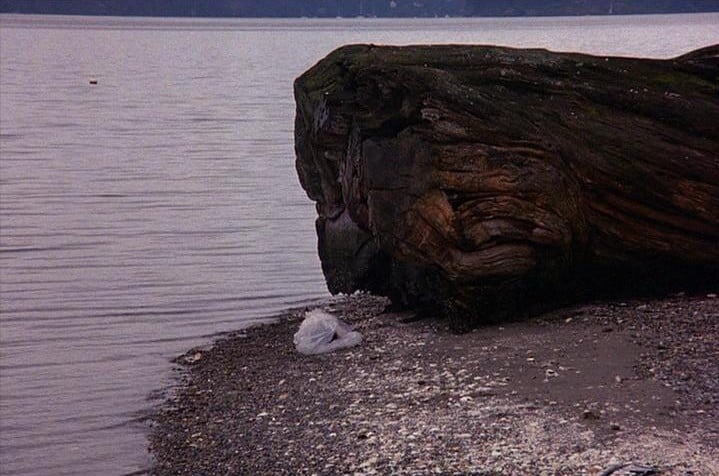
“Asleep” by a tree trunk
As I’m sure many of you know, the
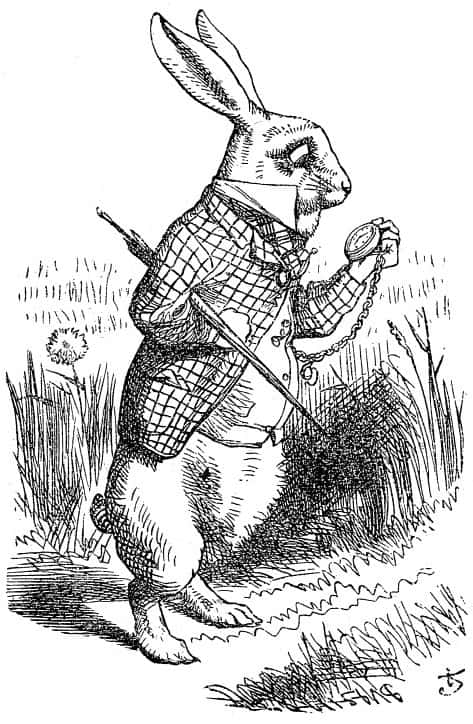
The White Rabbit is found
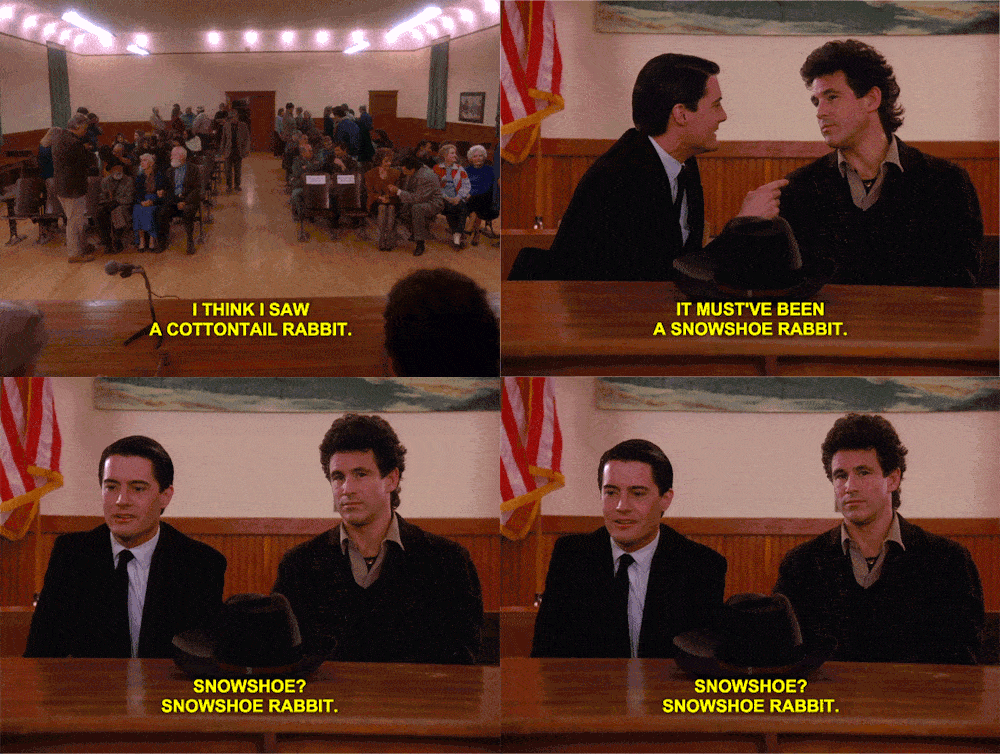
Ok, this one is THE one, you guys. My heart skipped a beat when I heard Agent Dale Cooper say it in the pilot. Before the town meeting where Cooper is introduced, Cooper tells Sheriff Harry S. Truman that he thinks he saw a cottontail rabbit. Truman informs him, “It must have been a snowshoe rabbit.” Cooper’s facial expressions infer a childlike wonder whenever he learns something new about
OH FYI, EVERYONE… A snowshoe rabbit looks like this:
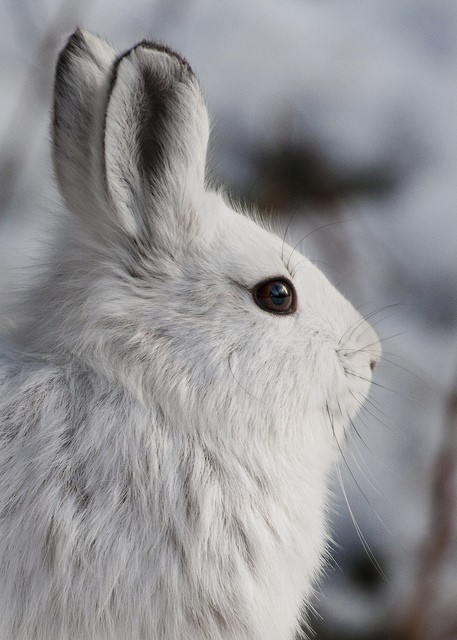
Snowshoe Hare, NPS Photo by Tim Rains via Flickr (CC License)
Put a little waistcoat on that fella and give him a good pocket watch, and we have ourselves the infamous White Rabbit, which Alice follows down the rabbit hole. Go ahead, I can wait while your little itty bitty hearts do a tap dance.
Dinah vs. Diane
“Dinah, my dear! I wish you were down here with me!”
—Alice’s Adventures in Wonderland
When we first meet Agent Cooper, he’s talking to himself… well, not quite to himself. He’s talking into his recorder, which will later be sent to his assistant Diane (who we never meet). This behavior mimics what Alice does with her cat named Dinah when she is not in Wonderland — she talks to it as if it’s a person while that cat (obviously) does not respond. Often, also, while Alice is in Wonderland without Dinah, she is making reference to Dinah and taking mental note out loud of what to tell Dinah later. Also, since we never actually meet Cooper’s Diane, she remains unresponsive in conversation, just like a cat would. On the
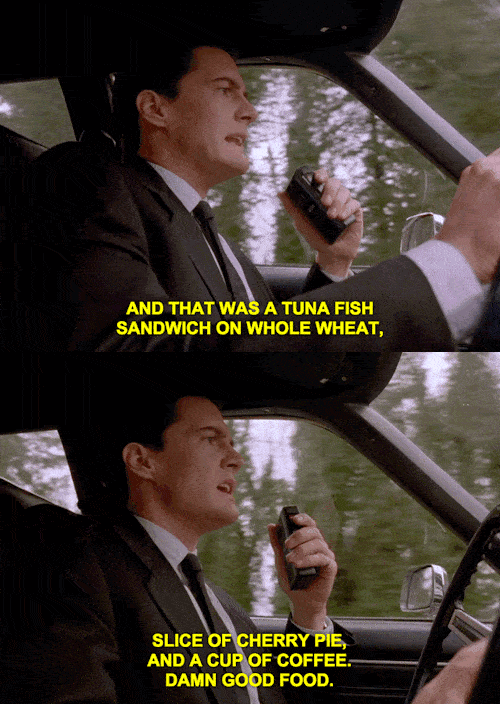
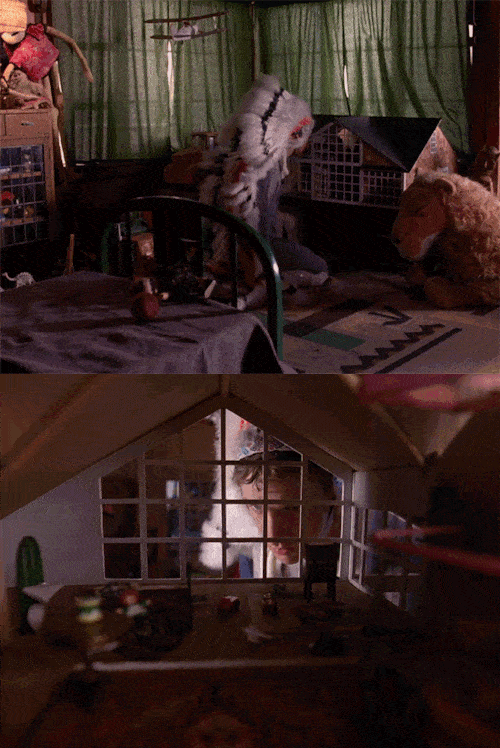
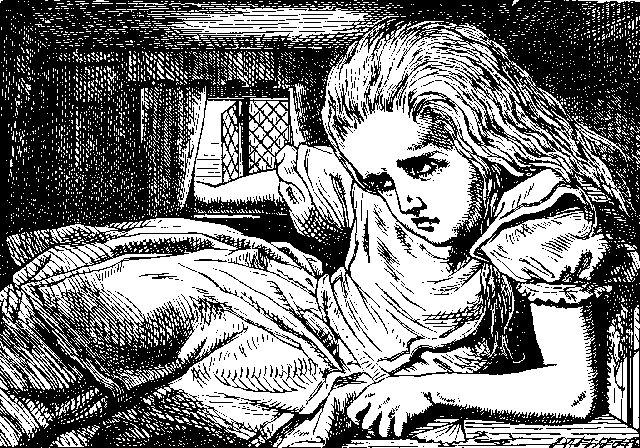
Growing and shrinking: too big for the house
In Alice’s Adventures in Wonderland, Alice eats and drinks a variety of things to shrink or grow in order to be the right size for the adventure she approaches or the obstacle that stands in her way. This scene from the
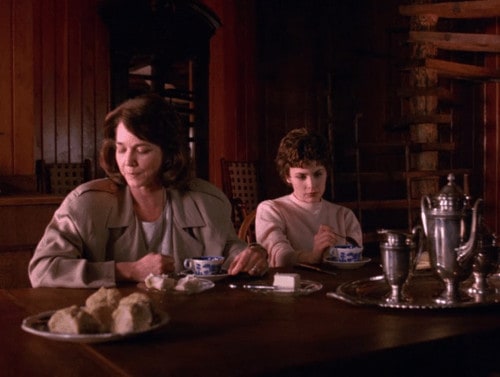
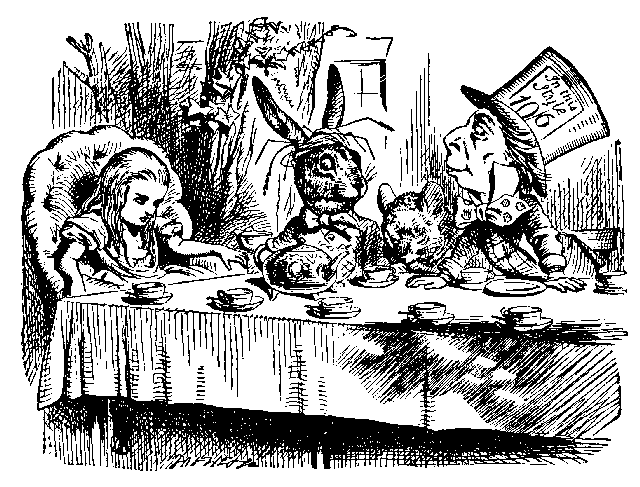
The Hatter’s food groups
In the same scene, Audrey and her mother sit at the table with tea, bread and butter. These three specific foods are the exact foods that are on the table at the Hatter’s tea party in Alice’s Adventures in Wonderland:
“Alice did not quite know what to say… so she helped herself to some tea and bread-and-butter.”
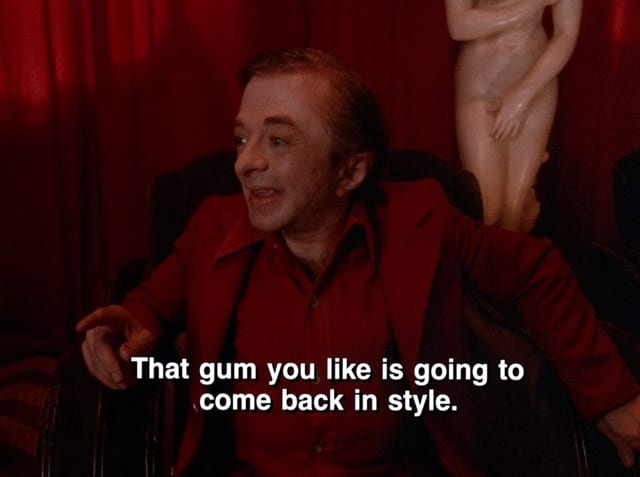
That gum you like: poetry and riddles
“Through the darkness of future past
The magician longs to see.
One chants out between two worlds
Fire walk with me.”
—Twin Peaks
Poetry and riddles come up constantly in
The way in which Lynch filmed the unsettling dream-world of the Red Room in The Black Lodge is also relevant in this respect. The nightmarish effect that Lynch achieves was produced by having the actors say their lines and do all of their movements backwards — which Lynch then reversed back to normal in post. In Through the Looking Glass, after Alice passes through the mirror and into the dream world, she discovers a book with a nonsensical poem inside that is seemingly written in gibberish, until she realizes that books are just written backwards on the opposite side of the mirror. She holds it up to a “looking glass” (mirror), and the words all go the right way again. Sound familiar? That’s the same start-in-reverse-then-reverse-again-to-look-normal technique mentioned above that Lynch used to create the Red Room scenes in The Black Lodge!
“YKCOWREBBAJ
sevot yhtils eht dna ,gillirb sawT’
ebaw eht ni elbmig dna eryg diD
,sevogorob eht erew ysmim llA
.ebargtuo shtar emom eht dnAShe puzzled over this for some time, but at last a bright thought struck her. ‘Why, it’s a Looking-glass book, of course! And if I hold it up to a glass, the words will all go the right way again.’ This was the poem that Alice read.
JABBERWOCKY
‘Twas brillig, and the slithy toves
Did gyre and gimble in the wabe;
All mimsy were the borogoves,
And the mome raths outgrabe.”
—Through the Looking Glass
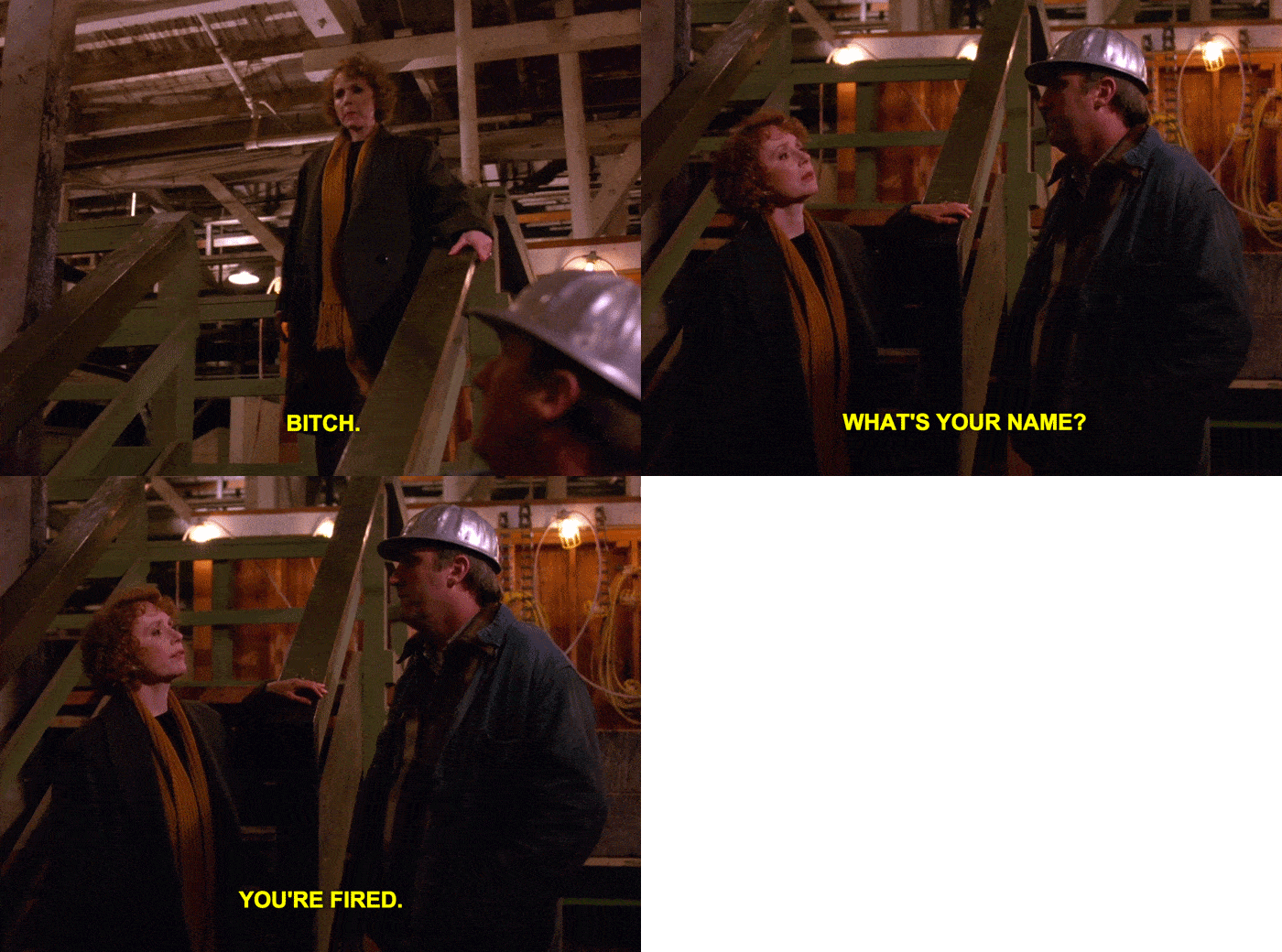
A kingdom full of cards
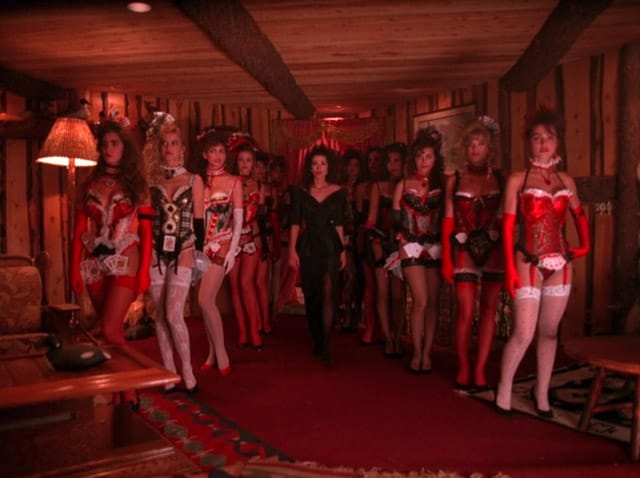
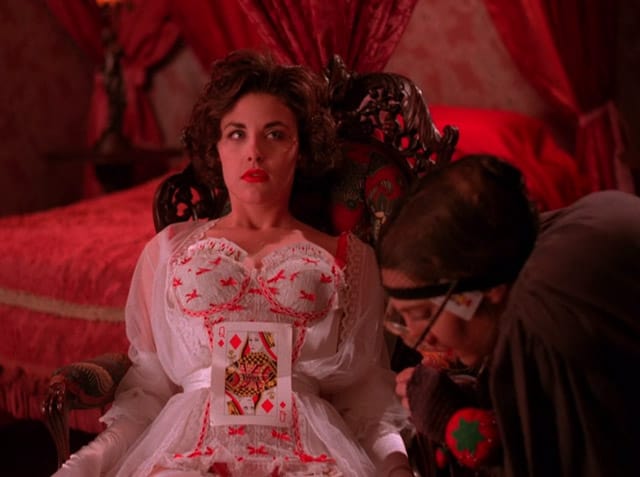
Cards play a major role in Alice’s Adventures in Wonderland. Personified cards march around obeying orders from The Queen of Hearts — a known terror that commands the slightest offense is deserving of her catchphrase, “Off with their heads!” In
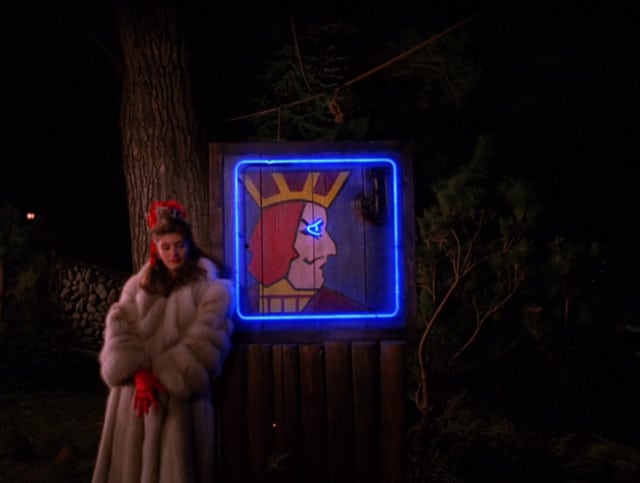
Expanding more on the theme of cards, One-Eyed Jack’s (referencing the royal card that only shows one eye) in

BOB vs. the Cheshire Cat
I’ll leave you with this final character connection… What grins widely, stares, creeps around and appears at random? Both the Cheshire Cat and BOB!
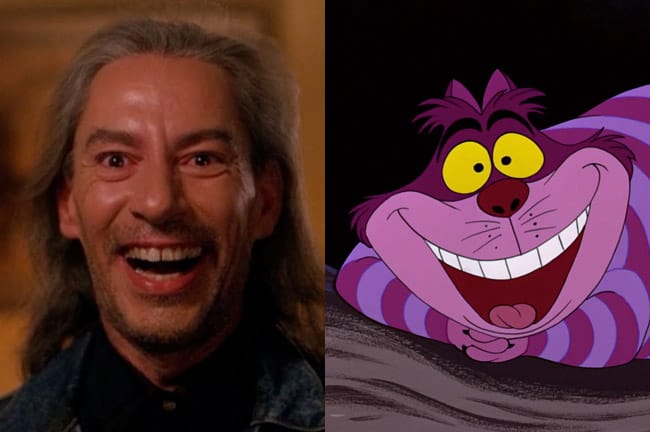
Have fun sleeping tonight with that image!
Read my posts on Twin Peaks & Wonderland in order:
- My Blog Has Something to Tell You
- Found in Twin Peaks: Alice’s Blue Dress, The Queen of Hearts and Hidden “Adventure”
- Down the Rabbit Hole: Video Supplement to Ep 1, Season 1 post
- Found in Twin Peaks: The White Rabbit, A Family of Hatters and Doppelgänger Donuts
- Found in Twin Peaks: White Rabbit Cocaine, Leo the Vicious Cat and Mistaken Identity
Bonus: “Don’t Go There” by Traumatron
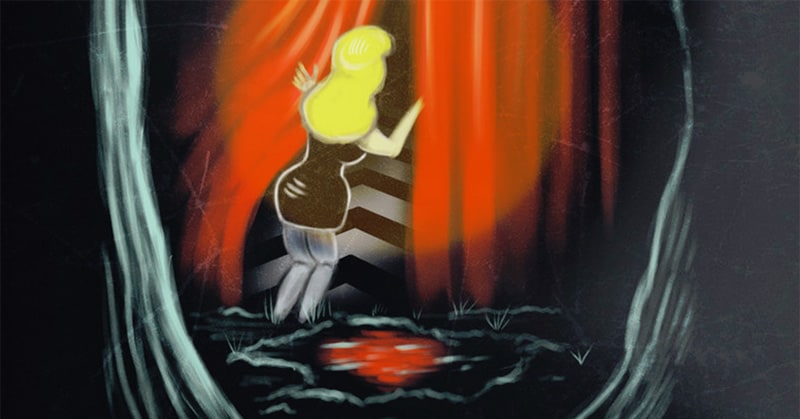
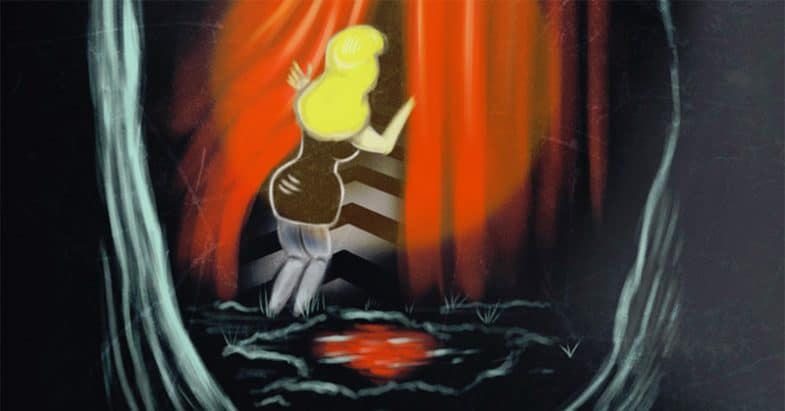
Traumatron (Colin Newman)’s alternative poster for Twin Peaks: Fire Walk with Me seems to channel the Sir John Tenniel‘s original illustration of Alice discovering a tiny door behind a curtain. The image is available as a poster (and other items).
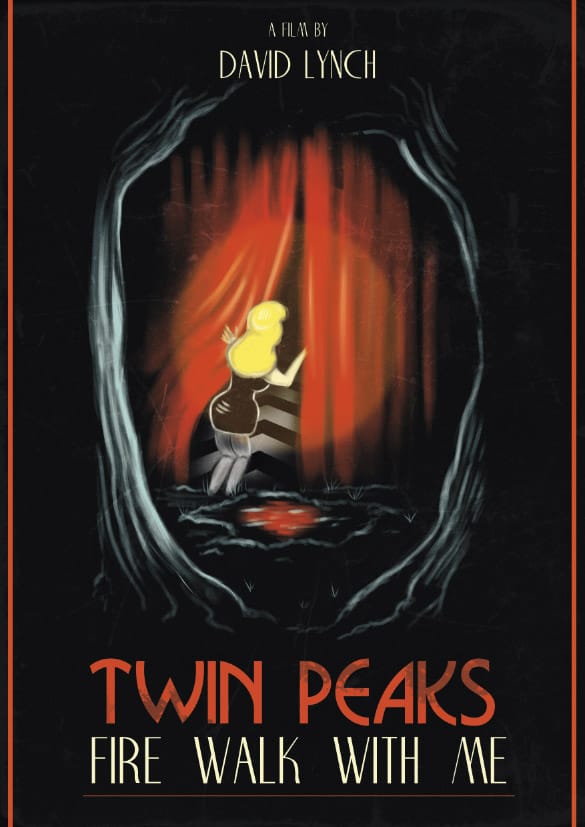


 Fire walk with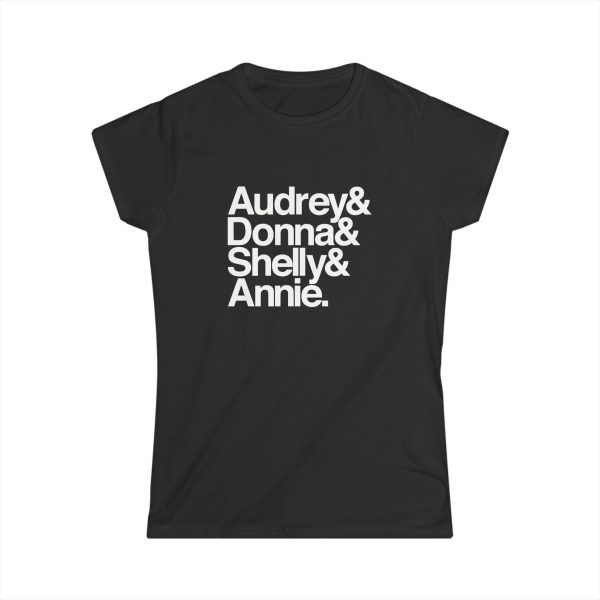
Moreover: COOPER + ALICE in Wonderland = ALICE COOPER!
(Just kidding, this interpretation is really interesting)
What a great read! Have sent it to all my Twin Peaks fan friends.
Also, Julee Cruise played the Queen of Hearts in a video version.
My husband just pointed out that he agrees with all parts except one… Diane has to be real because anytime Cooper asks Diane to do something, it gets done….
Earplugs, anyone?
I thought that the deleted scenes of FWWM made clear that Diane actually exists! In one of the scenes in Philadelphia we can see Cooper talking to her, even though we never actually see or hear her.
Diane is a fictional character in a fictional setting. Says my log.
Why does it take so long for someone to point this out? The one eyed jacks thing should have jumped out at us.
It not a tree trunk. It’s a rock.
No,it’s a tree trunk.
This was awesome! I would love to know if the similarities were intentional or just an amazing coincidence.
Not to be forgotten: The tag on one of Dr. Jacoby’s little umbrellas reads “August 9th 1974. I first lay eyes on Mimsy” recalling the line from Jabberwocky “all mimsy were the borogroves”.
I had a wonderful cat named Mimsy from 1997-2014 named after Jacoby’s dear one.
There’s another pretty obvious playing card connection – Windom Earle uses the four queens as representations of the four young women who feature in his plans. And while we’re on the subject of Earle, his chess game with Cooper could be said to mirror the chess game in Alice.
Interesting connection she makes her, but I am really annoyed by the way she writes. Why does every young American write nowadays think (s)he has to speak in this Californian teenage vocabulary… Where are the times when writers putted effort in using professional language, “y’all”?